A truckload into or out of Romania normally comes with a UIT code. A domestic run needs one only when it carries goods on the high-fiscal-risk list. The first question a haulier asks is whether it has to declare that code. Almost never. The party to the trade declares the transport in the ANAF system and passes the UIT to the carrier, and your work starts when the code arrives.
Who declares
RO e-Transport is the Romanian system that tracks road transport of goods. Its legal basis is Emergency Ordinance (OUG) 41/2022. The duty to declare, and so to get the UIT (the unique code the system generates), sits with named parties to the commercial operation: article 8 and, for international moves, article 8^1. A hired haulier is not on that list. ANAF's own clarifications say the duty "nu revine transportatorului", it does not fall on the carrier.
The carrier receives the UIT, keeps it on the truck and keeps the vehicle data right. Less work than declaring, but the fines at the end of this article apply to the carrier directly.
What the system covers
The OUG sets two scopes: domestic road transport of goods with high fiscal risk (the product list is in OPANAF 802/2022), and international road transport of any goods to or from Romania. The procedure order OPANAF 1.337/1.268/2024 sets the threshold. It applies to vehicles with a maximum permissible mass of at least 2.5 tonnes carrying a consignment above 500 kg gross or worth more than 10,000 RON.
| Situation | Who declares (OUG 41/2022) |
|---|---|
| Goods arriving in Romania from another EU state (intra-EU acquisition) | The Romanian beneficiary, art. 8(1)(b) and 8^1 |
| Goods leaving Romania for another EU state (intra-EU supply) | The Romanian supplier, art. 8(1)(c) and 8^1 |
| Domestic supply of high-fiscal-risk goods | The Romanian supplier, art. 8(1)(c) |
| A company moving its own stock between two points in Romania | That operator, art. 8(1)(e) |
| Goods held in a warehouse or in transit storage | The warehouse-keeper, art. 8(1)(d) |
Import and export follow the party named in the customs declaration. Intra-EU lanes, which is what most Eastern European carriers run, fall in the first four rows, and article 8^1 brings all goods on international moves into scope, whether or not they are on the high-risk list.
A company can file through a representative, a designated person or an authorised agent, always in the name of the party that owes the declaration (OPANAF 1.337/1.268/2024, art. 2). A forwarder or a shipper's agent may therefore do the clicking. That does not make you the declarant, and nothing in the text says it relieves the party who owes it. When a customer says "just declare it for me", ask who the declarant of record is and under whose tax ID the filing will sit.
The one case where a haulier declares is own-account transport: you move your own goods, and the law counts an operator transporting in its own name as an organiser of the transport.
What the haulier holds
The system notifies the Romanian parties other than the declarant, the carrier included, of the transport data and the UIT. On top of that the carrier has a few duties of its own.
The declarant must give the UIT to the transport operator at the latest when the vehicle is presented at the border or actually starts moving (art. 8(2)), and the operator must make it available to the driver (art. 8^2(4)). The driver shows the UIT with the accompanying documents when ANAF, Customs or the police ask (art. 10(1)). When the truck or trailer changes, the vehicle data on the UIT has to be updated before the new combination moves; the timing and the modifVehicul message are in the companion article on validity.
Article 8^2 separately obliges the operator to keep the vehicle's positioning data available for the whole route, through the vehicle's own telematics or a phone app. It is not part of the UIT, and the fines for it have been suspended more than once, so check with ANAF what applies on the day.
Before the truck leaves the yard
Put the UIT on the transport order as a required field and check the format and the dates: start date, expiry, truck and trailer plates. If the plates or the route in the declaration differ from the order, ask the customer who declared and have it corrected. Give the code to the driver before the truck moves, in a form that can be shown at a roadside check. A return or reload leg needs a new UIT, so expect the code to run out there.
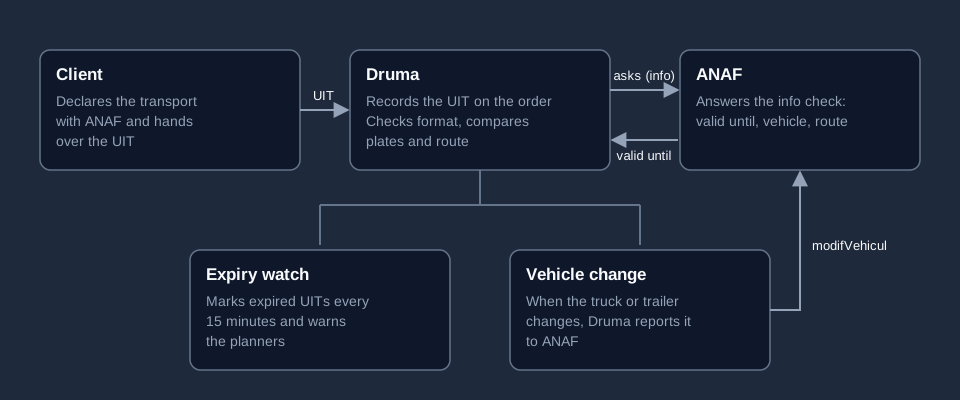
In Druma the client enters the UIT in the client portal, or the planner adds it to the order. Druma checks the format and the check digits, looks the code up with ANAF through your own ANAF connection, compares the declared plates and route with the order and warns the planners about a mismatch or an approaching expiry. Once the order is under way the UIT is linked to the truck and trailers carrying it and the driver sees it in the app. When the vehicle changes, Druma reports the vehicle change to ANAF. The declaration itself stays with the client, and the positioning duty with your telematics provider or the ANAF app; the ANAF e-Transport page has the whole flow.


The fines in article 13^1
An operator that breaches these duties (vehicle updates, making the UIT available, positioning) faces fines of 10,000 to 50,000 RON as a natural person and 20,000 to 100,000 RON as a legal entity. A driver who cannot present the UIT and the documents pays 5,000 to 10,000 RON. Using a UIT after it has expired is prohibited outright (art. 11).
Sources
Facts last checked October 25, 2026